
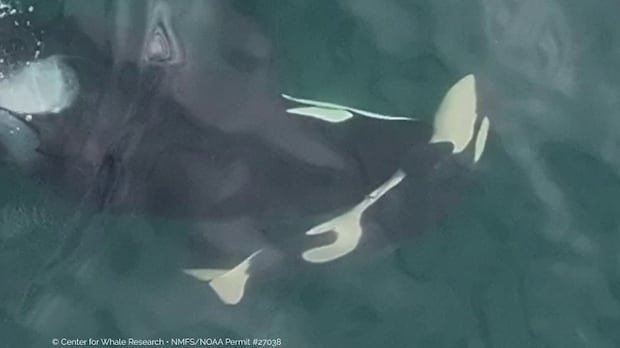
Whale experts reported that a southern resident killer whale, classified as endangered, was observed pushing a deceased calf in the Salish Sea on Friday. This sighting may evoke memories of a similar incident involving another mother whale in 2018, which gained global attention.
The Center for Whale Research (CWR) based in Washington state shared on social media that they received reports of the orca, identified as J36, in Rosario Strait, situated approximately 45 kilometers northeast of Victoria, Washington. Researchers from CWR discovered J36 pushing a lifeless female calf on Friday afternoon, with an umbilical cord still attached. According to CWR, the baby orca was likely born within the last three days.
The organization’s social media post indicated, “Based on the size of the calf, we estimate that the calf was either full-term or near full-term.” The cause of the calf’s demise, whether a stillbirth or post-birth mortality, remains unclear.
Notably, experts have suggested that the behavior of an orca pushing a deceased calf is often an expression of grief. Michael Weiss, the research director at CWR, highlighted the challenges faced by the southern killer whale population, with many pregnancies resulting in calves that do not survive or thrive.
Weiss emphasized the impact of environmental factors such as pollutants, specifically PCBs, which can compromise immune and reproductive functions. Additionally, the scarcity of prey, notably Chinook salmon, a primary food source for orcas, contributes to the reproductive challenges faced by these whales.
The emotional bond between a mother killer whale and her calf was underscored by Weiss, noting the enduring nature of their relationship. The mother orca nurtures her calf for three years following an 18-month gestation period, with the pair remaining part of the same family for life.
J35, another female orca from the J pod, gained attention in 2018 for carrying her dead calf for 17 days, covering over 1,600 kilometers, described as a poignant display of grief. Subsequently, in early 2025, J35 was once again observed pushing another deceased calf.
With less than 75 southern resident killer whales remaining, urgent conservation efforts are crucial to prevent their extinction, as highlighted in a recent report. The J pod, to which J36 belongs, is a distinct group within the southern resident killer whale population, known for frequenting the Salish Sea near Vancouver Island and Metro Vancouver, where they rely on salmon for sustenance.
Researchers from CWR were present at the scene on Friday to gather additional information about J36 and her deceased calf, with plans to release further details as they become available. The future survival of the southern resident killer whales hinges on immediate conservation actions to safeguard their population.

