
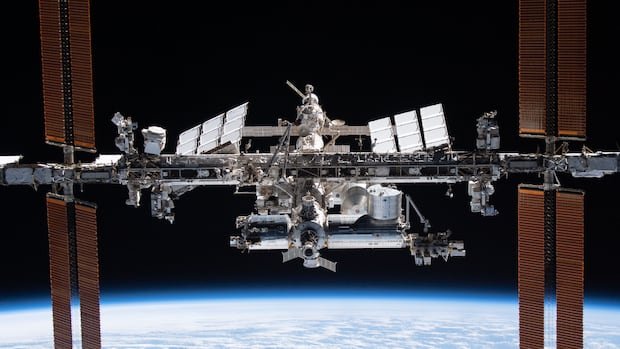
Historic structures, like Alexander Graham Bell’s residence in Nova Scotia, are often transformed into museums or national historic sites to safeguard their legacy for future generations. But what about a structure the size of a football field orbiting 400 kilometers above the Earth?
NASA’s official plan is to deorbit the International Space Station (ISS) at the end of its lifespan, sending it on a controlled descent back into Earth’s atmosphere for a crash landing in a remote ocean area. However, recent legislative advancements in the U.S. Government have prompted a reconsideration of this approach, proposing an exploration of the feasibility of storing the ISS in low Earth orbit instead.
Since its inception in 2000, the ISS has served as a continuous habitat for numerous astronauts from the U.S., Russia, Canada, Europe, and Japan. Assembled incrementally through multiple space shuttle and Russian launches, this colossal scientific laboratory, weighing over 400 metric tonnes, has hosted a myriad of experiments unique to microgravity conditions.
With its operational lifespan nearing its end, NASA announced in January 2022 that the ISS is set to be decommissioned by 2030 and deorbited by 2031. The current plan involves SpaceX providing a rocket to guide the ISS on a trajectory to burn up over the Pacific Ocean, mirroring the fate of its predecessor, the Russian Space Station MIR, which met a similar demise in 2001.
Despite these plans, some voices advocate for exploring alternative options before committing the ISS to its fiery fate. A proposal submitted by U.S. Rep. George Whitesides, a former NASA official, has gained initial bipartisan support in the House Science, Space, and Technology Committee. Whitesides emphasizes the need to fully evaluate the potential of preserving the ISS in orbit for future utilization.
However, preserving the ISS poses significant challenges. The station cannot be left unattended for long periods due to atmospheric drag causing it to gradually descend out of orbit. Simply boosting it to a higher orbit requires substantial fuel and raises collision risks with space debris, potentially adding millions of debris pieces to Earth’s orbit.
Moreover, sustaining the ISS demands ongoing maintenance to prevent deterioration and ensure safety. Despite NASA seeking private sector interest in taking over the ISS, no viable proposals have emerged, indicating the challenges of maintaining the aging station outweigh establishing new space habitats.
While NASA shifts focus towards lunar and Martian exploration, the concept of orbiting space stations persists, with China’s Tiangong already operational and private entities planning their space stations. The future may witness ambitious space hotel endeavors and innovative space habitats, but the fate of the ISS remains uncertain.
Ultimately, the journey to preserve the ISS as a historical relic faces complex logistical and financial hurdles, making the likelihood of its demise through atmospheric incineration and ocean descent the most probable scenario unless a groundbreaking solution emerges.

