
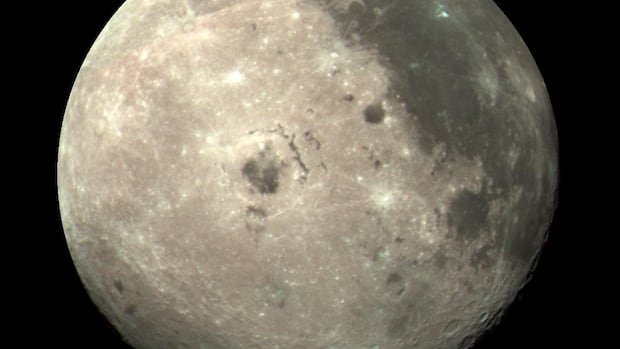
When Jeremy Hansen, a Canadian astronaut, embarks on the Artemis 2 mission, he will have the unique task of observing the far side of the moon, which remains unseen from Earth. Simultaneously, scientists on Earth will be monitoring this exploration closely, as they have plans to deploy telescopes and robots to investigate deep space from that vantage point.
The moon, being gravitationally tethered to Earth, always presents the same face to our planet while concealing its opposite side from view. Despite being commonly referred to as the “dark side,” the far side receives equal sunlight exposure compared to the Earth-facing side.
Distinguished by its rugged terrain and numerous craters, the far side of the moon contrasts with the smooth, Maria-covered near side. This region, shielded from Earth’s radio interference, holds great appeal for astronomers considering it as an ideal location for radio telescopes.
Accessing the far side of the moon is only possible through spacecraft, granting Hansen a rare opportunity to witness sights seldom seen by humans since the Apollo era. Unlike the Apollo astronauts who orbited close to the equatorial regions, Hansen’s Artemis trajectory will extend 7,500 kilometers beyond the moon, offering a panoramic view of Earth.
During the lunar flyby, Hansen and the Artemis crew will closely observe the lunar surface through the windows, leveraging the human eye’s ability to discern subtle details undetectable by cameras. These observations can reveal essential ground conditions crucial for future spacecraft landings.
Proposed missions to the far side, such as the Japanese TSUKUYOMI, aim to establish a radio telescope array to probe the early universe during the “dark ages,” when neutral hydrogen gas dominated and emitted faint radio signals. Detecting these signals could unravel the mysteries surrounding dark matter’s influence on the evolution of the universe.
Future projects like LuSEE Night from the University of Boulder Colorado and NASA’s Farside Seismic Suite are set to complement TSUKUYOMI by deploying robotic observatories on the moon’s far side. Additionally, both NASA and ESA have preliminary plans for lunar observatories while focusing on human missions for colony establishment and water ice exploration at the south pole.
While human endeavors on the moon prioritize practical objectives, the hidden far side will host a multitude of robots gazing into the cosmos, seeking answers about the universe’s origins.

