
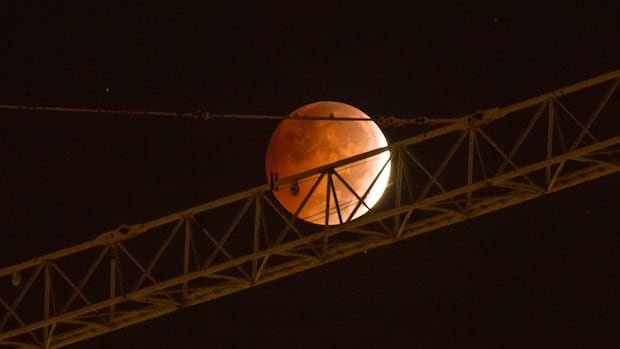
In the early hours of Tuesday, a total lunar eclipse will occur in Canada as the moon passes through Earth’s shadow. The visibility of the eclipse varies depending on the region. Western Canada, including B.C. and Yukon, will witness the entire eclipse, while the Prairie provinces will only see a partial eclipse as the moon sets in the west. Parts of Atlantic Canada will also experience a partial eclipse.
Observers will need to wake up early or stay up late to witness the event, as the eclipse will take place in the early morning hours. Unlike solar eclipses, lunar eclipses unfold over several hours with distinct phases. Initially, the moon passes through the penumbra, Earth’s faint outer shadow, causing minimal changes in brightness. Subsequently, the moon enters the umbra, Earth’s darker inner shadow, marking the partial phase where a portion of the moon may dim or disappear.
During a total lunar eclipse, the moon fully enters the umbra but retains a reddish or orange hue due to sunlight being filtered through Earth’s atmosphere. This phenomenon is often referred to as a “blood moon.” The varying colors are a result of different wavelengths of light being scattered or passing through the atmosphere.
The eclipse is expected to begin at 3:44 a.m. ET/12:44 PT when the moon enters the penumbra, with subtle changes in its appearance. The umbra phase starts at 4:50 a.m. ET/1:50 a.m. PT, followed by totality from 6:04 a.m. ET/3:04 a.m. PT to 7:03 a.m. ET/4:03 a.m. PT. However, viewers in the eastern time zone may miss the totality phase as the moon sets earlier. Residents of Alberta, Saskatchewan, and Manitoba will witness the entire totality phase.
For precise timings and details based on location, individuals can refer to TimeandDate. Paul Delaney, a professor emeritus of physics and astronomy at York University, advises dressing warmly for optimal viewing comfort during the eclipse. Additionally, he suggests planning photography based on the moon’s position relative to surroundings, with the moon likely low on the horizon for most viewers.

