
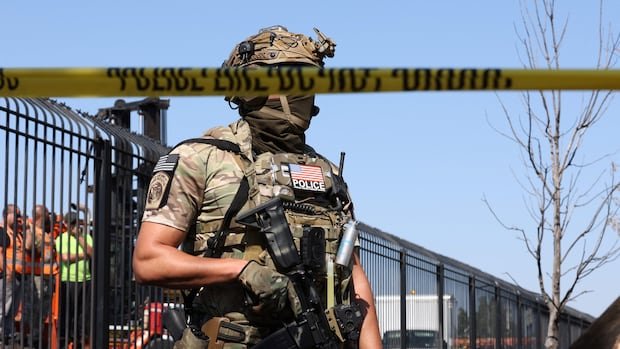
U.S. Border Patrol officials shot an armed woman in Chicago over the weekend, according to the U.S. Department of Homeland Security. This incident occurred as Governor of Illinois revealed plans by the Trump administration to mobilize and deploy hundreds of National Guard troops to the state.
The woman was shot following a confrontation between protesters and federal immigration agents in Chicago’s southwest area. A Department of Homeland Security spokesperson stated that during the altercation, the woman, along with others, intentionally crashed vehicles into those used by U.S. Immigration and Customs Enforcement (ICE) without causing severe harm to law enforcement officers.
The woman, an unidentified U.S. citizen, drove herself to the hospital. Further details about her condition were not immediately available. ICE agents responded to the situation by using pepper spray and rubber bullets during clashes with protesters.
U.S. Secretary of Homeland Security Kristi Noem announced the dispatch of additional “special operations” to manage the situation in Chicago’s Brighton Park neighborhood. Protesters, who were attempting to impede ICE vehicles transporting detainees, faced forceful actions from heavily armed ICE agents, including the use of physical force, chemical agents, and rubber bullets, creating scenes reminiscent of military conflict.
Similar heavy-handed law enforcement tactics in other Democratic-controlled cities like New York, Los Angeles, Washington, D.C., and Portland, Oregon, have drawn criticism from protesters. Governor of Illinois, JB Pritzker, disclosed that the state’s National Guard had been notified by the Pentagon that 300 troops would be called up, though specific deployment details were not provided. President Trump had previously threatened to send troops to Chicago.
Pritzker condemned the federal directive as an unwarranted intrusion into state affairs, emphasizing the importance of respecting state sovereignty. He criticized the ultimatum as un-American, highlighting the potential impact on National Guard members and their families. The Governor stressed that the safety of the ICE facility near Chicago was being managed by state, county, and local law enforcement coordination efforts.
The move to escalate federal law enforcement presence in Illinois mirrors similar actions taken in other regions. Trump had previously deployed the National Guard in Los Angeles and Washington, D.C. In response to these deployments, California Governor Gavin Newsom successfully obtained a temporary restraining order against the use of the National Guard in Los Angeles. However, the Trump administration has appealed the ruling, with a federal court indicating a likelihood of government success.
In Oregon, a federal judge blocked the deployment of troops to Portland, a decision welcomed by Governor Tina Kotek. The ongoing protests at the U.S. Immigration and Customs Enforcement building in Portland have contributed to the legal battles over federal troop deployments in various states. Governor Kotek emphasized the need to protect democracy against what she perceived as threats led by President Trump.
The situation in Portland prompted the Defense Department to place Oregon’s National Guard members under federal control temporarily, a move later halted by a court order. Governor Kotek reiterated that despite the protests, there were no significant incidents of civil unrest warranting federal intervention in Oregon.

