
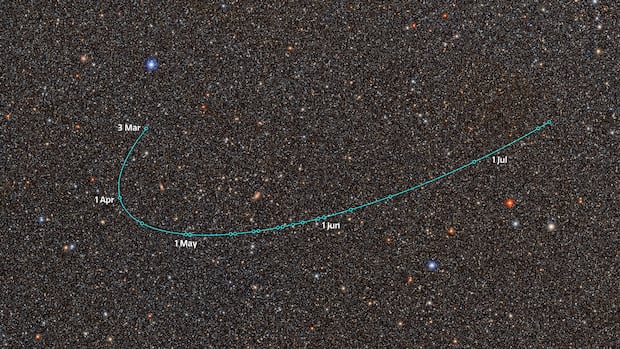
Using a telescope located in Chile, scientists have discovered a cold celestial object orbiting beyond Pluto that could potentially be added to the limited number of dwarf planets in our solar system.
According to researchers, this new candidate, designated as 2026 ED138, has an estimated diameter ranging from approximately 600 to 1,500 kilometers and is situated about 46 times further from the sun than Earth. For comparison, Pluto orbits at an average distance of about 40 times farther from the sun than our planet.
The object was detected with the newly operational Vera C. Rubin Observatory, perched on the summit of Cerro Pachón in central Chile. This telescope is a collaborative project between the U.S. National Science Foundation and the U.S. Department of Energy.
Additional observations are required to verify that this object qualifies as a dwarf planet.
If confirmed, 2026 ED138 would join the ranks of five other dwarf planets acknowledged by the International Astronomical Union, which serves as the authoritative body for classifying celestial objects. These include Pluto, Eris, Haumea, and Makemake, all of which orbit beyond Neptune, the farthest planet from the sun, as well as Ceres, found in the main asteroid belt between Mars and Jupiter.
Based on the information available, 2026 ED138 appears to be one of the largest potential dwarf planets.
Astrophysicist Matt Holman from the Center for Astrophysics at Harvard & Smithsonian, who was the first to detect 2026 ED138, remarked, “This illustrates that many thrilling discoveries are still to be made with the Rubin Observatory and other telescopes.”
-
NASA is launching the Nancy Grace Roman Space Telescope. Here are just a few of the wonders it will reveal
-
New giant telescope reveals its 1st images of our universe
Once considered the ninth and furthest planet in our solar system, Pluto was reclassified as a dwarf planet by the International Astronomical Union in 2006 due to its failure to meet the official criteria for a planet. Both Pluto and the newly identified dwarf planet candidate inhabit a chilly sector of the solar system filled with various icy objects.
Questions linger
Questions still exist regarding the size and composition of 2026 ED138. To be classified as a dwarf planet, an object must have enough mass for its gravity to shape it into a spherical form. While 2026 ED138 seems to possess sufficient mass, further observations are necessary.
Holman stated, “The key task is to determine the physical dimensions of 2026 ED138.”
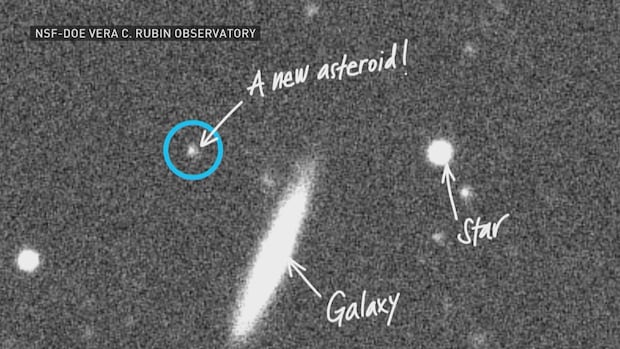
This video, released Monday by the team behind the Vera C. Rubin Observatory, shows images of more than 2,000 new asteroids.
“When we observe with Rubin, we see the sunlight reflecting off the object,” Holman explained. “A smaller, highly reflective object may reflect the same amount of light as a larger, less reflective one. Luckily, by examining longer wavelengths using an observatory like ALMA, we can detect the light emitted from the object itself,” which aids in determining its size.
ALMA, or the Atacama Large Millimeter/submillimeter Array, represents another powerful telescope located in Chile.
The announcement of this discovery was made during a scientific conference in Spokane, Washington.

