
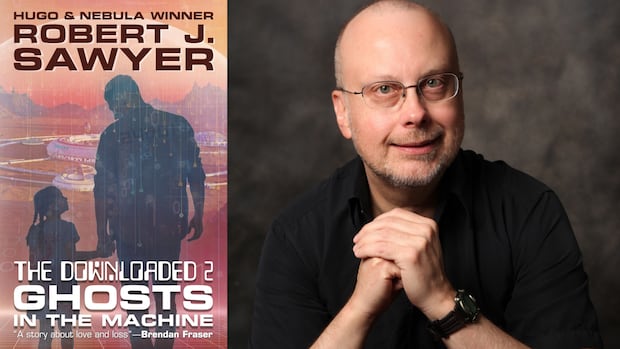
It’s clear that Robert J. Sawyer takes great pleasure in being a science fiction author. His license plate even states “SF Writer.”
However, upon receiving a diagnosis of an untreatable cancer, he feared that the treatment—which is known to induce brain fog—would hinder his ability to write.
“There’s nothing else that brings me joy or sustains me as a career other than writing,” he shared on an episode of Bookends with Mattea Roach.
“I believed that losing that identity would mean losing a part of myself.”
Discussions with loved ones, however, led him to a revelation: he could identify himself in ways beyond being a writer.
“Being a writer is incredibly important to me, but if I couldn’t pursue it any longer, I could still lead a fulfilling life for however long I have left.”
Fortunately, Sawyer achieved remission without suffering from brain fog and has since authored two additional books.
In The Downloaded 2: Ghosts in the Machine, Sawyer explores the profound questions he faced while confronting his own mortality. The narrative unfolds in a reality where individuals can transfer their consciousness into a computer while their physical bodies are cryogenically preserved, suspended in slumber.
Sawyer appeared on Bookends to delve into the philosophical themes that shape his science fiction and to discuss how he believes science and religion are more interconnected than many realize.
This conversation has been edited and condensed. Interview produced by Lisa Matthews.
These topics—consciousness, mortality, and the essence of our identity—are subjects you’ve contemplated for quite some time, even before facing them in a personal, existential context. What sparked your interest in these areas?
As a teenager in the 1970s, I was captivated by a television show called The Six Million Dollar Man, which featured a character who was part human, part machine. This concept resonated with the cultural atmosphere of the time, suggesting that advancements in technology could help overcome the limitations of aging or cognitive decline. As a sci-fi author, this is incredibly appealing—it’s a goldmine for story ideas.
In The Downloaded 2: Ghosts in the Machine, my characters experience the process of being uploaded and subsequently downloaded.
I never had this desire to be anything other than homo sapiens, a normal human being.Robert J. Sawyer
I have never personally felt drawn to such transformations. Even when [during my treatment, I was presented with various] technological options, including an autologous stem cell transplant—which is essentially science fiction—I thought, “Oh, that sounds interesting, and the insurance will cover it, so why not?”
But I never had the urge to be anything other than a normal human being.
You wrote The Downloaded series during your cancer treatment, even giving one of the characters the same type of cancer you’ve been battling. What insights were you able to explore through fiction that you couldn’t tackle in your real life at that moment?
I assigned one of the characters the same illness, but set it 20 years prior to my diagnosis, when it would have been an absolute death sentence.
This character’s only choice was either to die or undergo cryogenic suspension. Thus, I was able to deeply explore the existential dilemmas I was facing and amplify them—as is often done in fiction. I exaggerated my own struggles to the point where he had no alternatives: there were no treatments available.
When I was diagnosed, they informed me, “We can bring you into remission for a certain number of years, but eventually, you’ll die.” Now, they’re saying, “We can achieve remission, and when it recurs, we have new treatments that may allow you to stay ahead of the advancements in cancer research.”
That was my reality, but it was not the fate of my character. This distinction allowed me to clarify the choices dramatically.
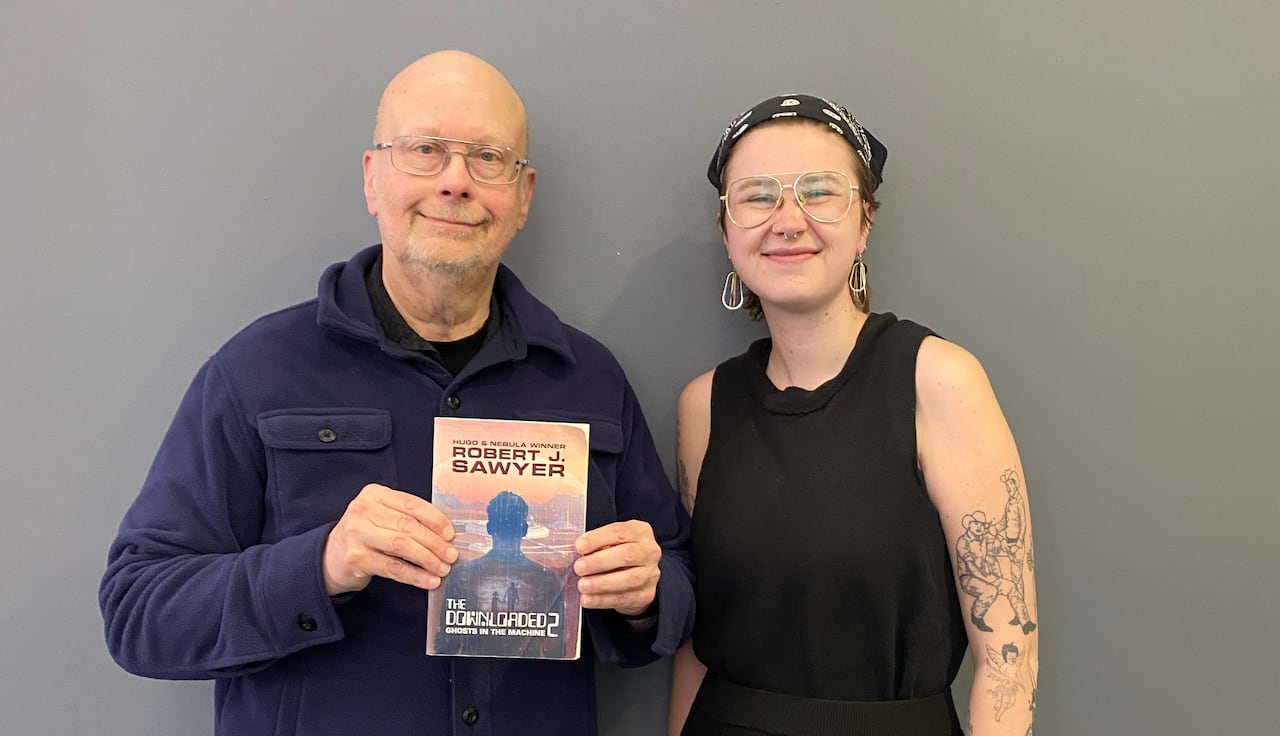
Robert J. Sawyer, left, and Mattea Roach pose at CBC Toronto after their Bookends conversation. (CBC Books)
Throughout this discussion, you’ve hinted at the idea that technology can reach a level of mystique, bordering on the incomprehensible, similar to the way spiritual matters can feel beyond human understanding. At one point, a young character in your novels perceives a quantum computer almost as a deity. What links do you see between science and spirituality?
Stephen Jay Gould, a paleontologist and one of my role models, wrote a book positing that science and religion operate in non-overlapping domains. They are unrelated.
I disagreed with that perspective. They represent two distinct methods of exploring profound questions. If both are addressing similar inquiries—such as our origins, our purpose, and the possibility of an afterlife—they are undeniably interconnected.
I was fortunate to win the Nebula Award for Best Novel in 1996 for my work The Terminal Experiment. This book centers on a biomedical engineer who uncovers scientific evidence supporting the existence of God.
Throughout my career, I have engaged in the dialogue between science and religion. In fact, I take pride in being awarded an honorary doctorate from the University of Winnipeg, jointly sponsored by the Dean of Science and the Emeritus Dean of Religion, recognizing my ongoing exploration of this dialogue.
My rise to becoming a top 10 bestseller in this country occurred when Tom Harpur, a religion columnist for the Toronto Star, wrote about my novel Calculating God. Suddenly, my status shifted from that of a genre fiction writer to a top national bestseller.
This change happened because he remarked, “Here’s a science fiction novel that engages with philosophical and theological issues without belittling them.”
Do people generally feel that literature should always be serious and philosophical? Is there a notion that science fiction often dismisses those significant questions?
There is a common perception that science fiction often represents atheistic literature.
Some of my colleagues are deeply religious—Muslim, Christian, Jewish, Hindu—but overall, there exists a sentiment that as we progress toward a technological utopia, we will transcend the need for spirituality and the extraordinary. This perspective seems implausible to me as a writer of science fiction.
Since the dawn of homo sapiens 200,000 years ago, we have been a spiritual people. The belief that in the coming decades, or even centuries, we will reach a final realization that everything is rational and devoid of the supernatural is something I do not believe will occur for homo sapiens. Thus, I embrace this complexity in my work. I may not share the same beliefs, but I respect those who approach life through a different lens.

