
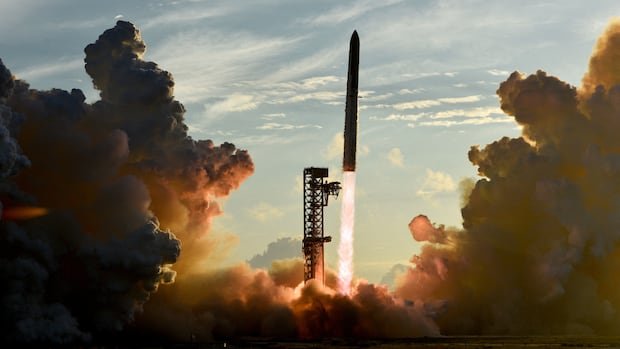
SpaceX successfully launched its massive Starship into orbit for the first time on Monday, delivering the most advanced Starlink satellites to date. The flight, however, was cut short, with the spacecraft splashing down in the Pacific Ocean after just over three hours instead of the planned 10-hour flight encompassing six full orbits around Earth to demonstrate readiness for NASA’s Artemis moon program.
During liftoff, one of the engines shut down prematurely, almost jeopardizing the mission. However, after assessing the situation and confirming all other systems were functioning correctly, flight controllers decided to proceed with the mission as scheduled, declaring “Starship is orbital” to cheers from SpaceX mission control.
The Starship rocket, designed by founder Elon Musk, carried 26 advanced Starlink satellites to join the existing 11,000 satellites providing internet services. These new satellites were successfully deployed from the spacecraft, eliciting more excitement from spectators at the Starbase launch site in Texas.
Following the satellite deployment, the decision was made to end the flight earlier than planned, with no specific reason provided. This launch marked Starship’s 14th full-scale mission from Texas, a significant milestone for the company’s space exploration efforts.
While the spacecraft achieved the intended orbit at an altitude of 275 kilometers and was on track to complete six orbits over 10 hours, the mission was shortened after just a couple of laps for safety reasons. The booster stage was not intended to return to the launch site but instead landed in the Gulf of Mexico shortly after liftoff.
SpaceX emphasized the importance of ensuring the spacecraft’s safety before attempting to recover it, highlighting the necessity of cautious operations to maintain public support. The company aims to refine its procedures and potentially introduce giant mechanical arms for capturing the returning Starship in future missions.
SpaceX’s ultimate goal is to certify Starship for orbital flights to advance its ambitions for moon and Mars exploration. The upcoming Artemis III mission, scheduled for next summer, involves complex docking maneuvers in orbit between various spacecraft, including Musk’s Starship.
With ongoing developments and modifications based on previous missions, SpaceX is striving to establish Starship as a fully reusable and cost-effective rocket for future space missions. The company’s dedication to space exploration and innovation continues to shape the future of commercial space travel.

