
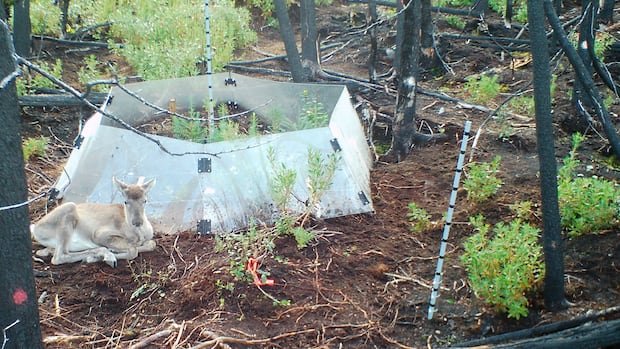
A researcher’s study on forest regrowth after wildfires in Atlantic Canada faces interruptions from curious wildlife. Lucas Brehaut, a wildfire scientist, is investigating the impact of climate change on forest recovery post-fire. To simulate warmer conditions, his team placed 19 open-top chambers (OTCs) around seedlings in the forest. These OTCs function as mini greenhouses, elevating temperatures by up to three degrees.
However, wildlife, including caribou, moose, black bears, rabbits, coyotes, and owls, have been interfering with the research equipment. Surveillance cameras revealed that animals not only trampled the greenhouses but also took off with temperature sensors. Out of the 19 sites, 11 suffered damage at various times, causing disruptions to the study.
Despite these setbacks, Brehaut remains understanding, acknowledging that animals are merely exploring their habitat. Kaitlyn Gaynor, an expert from the University of British Columbia, supports this perspective, explaining that animals are naturally curious about new objects in their environment. She highlights that animals may investigate objects due to their scent left by humans.
Animal interference in research is a global issue, as Gaynor witnessed in Africa. She recounted incidents involving baboons, hyenas, and elephants disrupting research activities. Gaynor emphasized that animals pose a significant challenge to research equipment due to their inquisitive and sometimes destructive behavior.
While wildlife disturbances are common, Brehaut has also encountered human-related challenges. Snowmobiles inadvertently damaged his research sites during snowy winters in Newfoundland. Despite these obstacles, researchers like Brehaut continue their vital work, navigating through the complexities of nature and wildlife interactions.

