
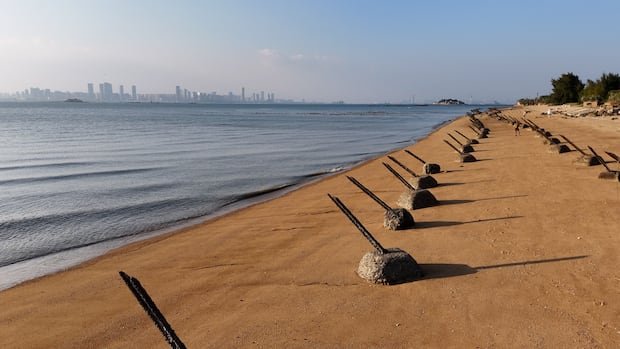
Kinmen, a place situated close to a rival and often hailed as the “front line of democracy,” exudes a relaxed atmosphere. Mainland Chinese tourists frequent this Taiwanese outpost, arriving via ferry from Xiamen, just a few kilometers away. The main draws are historical war sites narrating the islands’ tumultuous past since the 1949 Chinese civil war.
Local guide Jerry Wu, recounting the wartime conditions on Kinmen’s beaches, likened them to the Normandy landings’ intensity. Despite Beijing’s claim over Kinmen and Taiwan, tensions are palpable as the U.S. President is anticipated to discuss Taiwan’s future with Chinese leadership.
U.S. intelligence hints at a potential Chinese invasion of Taiwan by 2027, adding uncertainty to the U.S.-Taiwan relationship under President Trump’s administration. The unpredictability in Trump’s China policy has raised concerns among Taiwanese, fearing their security may be used as a bargaining chip.
China’s leader is reportedly pressuring Trump to reject Taiwan’s independence, diverging from the status quo maintained by previous administrations. With China displaying more aggressive military behavior towards Taiwan, concerns are mounting about a possible conflict despite various obstacles hindering a swift invasion.
Taiwan is bracing for potential conflict by extending national service and bolstering defense capabilities, including a proposed missile defense system. Preparedness courses aim to enhance the populace’s resilience, with growing participation attributed to escalating tensions with mainland China.
While the conquest of Kinmen would be a more feasible military endeavor compared to seizing Taiwan’s main island, its capture could ignite Taiwanese unity against the mainland. Amidst uncertainties, locals like Jerry Wu remain cautious, believing that while provocations may persist, an imminent war seems unlikely.

