
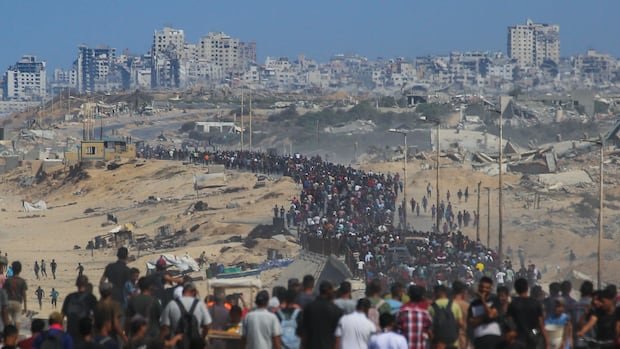
After a period of intense airstrikes, the surviving Israeli captives have been freed, and Palestinian detainees in Israeli jails have been returned to their families. The future of the broader Middle East agreement brokered by Donald Trump remains uncertain. Although moments of tension have surfaced recently, any semblance of peace in a region plagued by prolonged conflicts deserves recognition.
Trump proclaimed an end to the two-year Gaza war on Tuesday as a significant milestone towards a “new Middle East.” However, this ceasefire agreement only temporarily halts the violence in a protracted and agonizing Middle Eastern conflict that remains unresolved over decades.
The recent deal brokered by Trump, while bringing a pause to the immediate bloodshed, epitomizes a “negative peace” – a mere absence of violence that fails to address the underlying issues fueling the conflict. Trump’s rhetoric suggested a transformative shift towards peace in the region, highlighting Israel’s actions against Hezbollah and Iran, the dismantling of Hamas, and the groundbreaking Abraham Accords signed in 2020 by four regional nations, normalizing relations with Israel.
Despite acknowledging the historical rifts in the Middle East during his recent visit, Trump fell short of outlining a concrete plan for a lasting resolution between Israelis and Palestinians. His 20-point proposal vaguely alluded to fostering dialogue and shifting mindsets towards peace without explicitly endorsing a two-state solution, a departure from previous U.S. administrations’ stance.
The omission of a clear pathway towards Palestinian statehood in Trump’s plan raised concerns about the feasibility of achieving a credible peace settlement. Trump’s approach, largely shaped by Israeli interests and input from Arab leaders, has been criticized for sidelining Palestinian voices and lacking a comprehensive strategy for sustainable peace.
The absence of a roadmap for a two-state solution in Trump’s initiative diverges from the traditional U.S. approach to the conflict, alienating key global allies and highlighting a shift in American policy towards the Middle East. Despite vague assurances of potential progress towards Palestinian self-determination, the core aspirations of the Palestinian people were notably absent from the agreement.
Creating a lasting peace between Israelis and Palestinians has remained a formidable challenge for successive U.S. administrations, with repeated cycles of violence and stalled negotiations underscoring the complexity of the conflict. Achieving a transformative “positive peace” requires dedicated mediators, diplomatic efforts, and incentives to bridge deep-seated divides, akin to the process that led to the Good Friday Agreement in Northern Ireland.
While the recent ceasefire marks a crucial initial step, it is evident that resolving decades-old regional conflicts demands sustained commitment and robust international engagement. Canadian Prime Minister Mark Carney emphasized the long road ahead to stability and peace, cautioning against overstating the immediate impact of the recent agreement as a definitive solution to the region’s deep-rooted challenges.

