
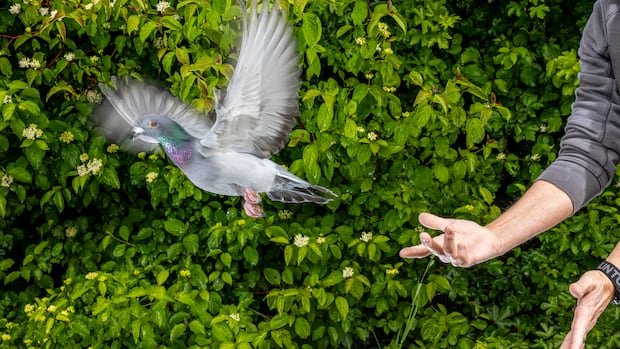
In a remarkable revelation, scientists have unearthed a surprising method of navigation employed by pigeons. During a critical moment in the First World War, a homing pigeon named Cher Ami played a pivotal role in saving trapped soldiers by delivering a crucial message through heavy fire. Cher Ami’s heroic act is a testament to the historical reliance on pigeons for long-distance message delivery, dating back to ancient times.
Researchers have long understood that homing pigeons navigate using various cues such as the sun, scents, and visual landmarks. However, the mystery surrounding how pigeons utilize the Earth’s magnetic field for navigation has puzzled scientists for years. Clivia Lisowski, an immunologist at the University of Bonn, and her team have now put forth a groundbreaking theory. They propose that iron-rich immune cells in the liver function as sensors that detect the Earth’s magnetic field, aiding in the birds’ navigation.
This innovative idea stemmed from previous research in mice, where it was observed that immune cells in the spleen accumulate iron, making them sensitive to magnetic fields. Collaborating with animal behavior scientist Martin Wikelski, the researchers identified a high concentration of iron in the livers of pigeons. These iron-rich immune cells, known as macrophages, play a crucial role in breaking down old red blood cells and extracting iron, which may contribute to the birds’ magnetic orientation.
To test their hypothesis, the team temporarily depleted macrophages in pigeons and released them in challenging conditions with no external cues available. The results were striking – pigeons without functional macrophages struggled to orient themselves, highlighting the significance of these immune cells in navigation. This discovery has garnered praise from experts like David Bird, emphasizing the potential implications for understanding navigation in other migratory creatures.
Scott MacDougall-Shackleton, from Western University, lauds the research for its novelty and potential insights into human biology. While the findings open up new avenues of exploration, further research is needed to confirm the mechanism and rule out alternative explanations. The study marks a paradigm shift in understanding the immune system’s sensory capabilities and its role beyond conventional defense mechanisms.

