
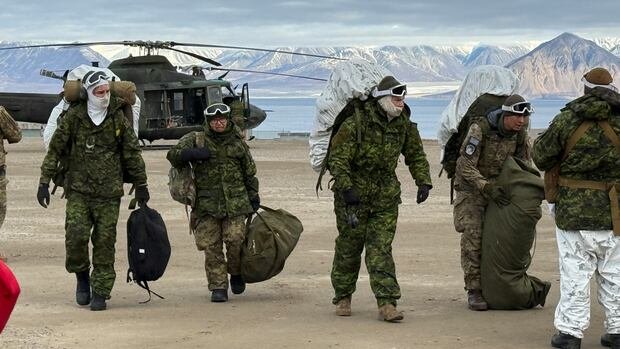
In a remote area more than 3,000 kilometers north of the Canadian capital, the country’s Armed Forces recently conducted a gathering involving soldiers, ships, and aircraft. The primary focus was on strategizing how to approach a scenario involving boarding a foreign vessel attempting to remain undetected and unimpeded.
The hypothetical situation involved the vessel’s proximity to sensitive military locations in the North, where smaller boats frequently navigate without transponders, making them challenging to track from a distance or by satellite surveillance systems. This annual military exercise, dubbed Operation Nanook, gained increased significance this year due to various geopolitical shifts, including China’s expanding interests in the Arctic, Prime Minister Mark Carney’s military enhancement plans, and the rising importance of minerals in the region.
Exclusive access to the military and coast guard maneuvers was granted to CBC News, coinciding with heightened attention from traditional Canadian adversaries towards the North’s critical mineral resources. The emergence of new shipping routes through the Northwest Passage, facilitated by climate change-induced ice melting, has also attracted global interest.
China, in particular, has been closely scrutinized for its Arctic pursuits, with concerns raised about its intentions to control rare-earth elements and mining activities in the Canadian Arctic. These valuable resources, including copper, nickel, lithium, graphite, and cobalt, are abundant in the region.
Recent monitoring efforts by Canada’s military and coast guard revealed the presence of Chinese vessels in Arctic waters. Surveillance data indicated Canadian aircraft tracking Chinese research vessels, emphasizing the dual-purpose nature of these ships, capable of both scientific research and potentially military data gathering.
The changing geopolitical landscape in the Arctic has prompted a renewed focus on the region’s economic prospects and the well-being of its inhabitants. Calls for investment in local infrastructure, such as hydropower and housing, have intensified to ensure community development and sovereignty assertion.
The involvement of coast guard and naval assets in a recent military exercise showcased Canada’s readiness to respond to potential threats in domestic waters. The scenario involved intercepting a suspect vessel, highlighting the collaborative efforts between naval and law enforcement authorities to address security challenges in the Arctic.
Upgrades in Canada’s defense capabilities, including the replacement of aging surveillance aircraft with more advanced models like the P-8 Poseidon, demonstrate the country’s commitment to enhancing its maritime security posture. Collaborative initiatives with international partners, such as Australia, to develop new radar systems further underscore Canada’s efforts to bolster its defense capabilities in the Arctic.

