
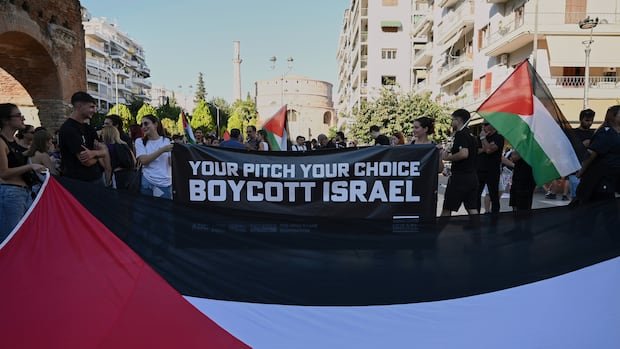
Amid the ongoing uncertainties about their qualification, Israel may encounter hurdles on their path to the 2026 FIFA World Cup. A Canadian human rights organization has recently added its voice to the chorus advocating for the suspension of Israeli soccer teams from international competitions due to the conflict in Gaza.
Just Peace Advocates, a Palestinian-solidarity group based in Toronto, has penned a letter urging Canada Soccer to publicly call for the suspension of the Israeli Football Association. The letter, endorsed by 270 individuals including academics, legal experts, journalists, and advocates, also demands that Canada refrain from hosting the upcoming World Cup if Israel remains a participant.
Vancouver and Toronto are slated to be co-host cities for the 2026 World Cup, jointly organized by Canada, the U.S., and Mexico. Citing both its own bylaws and FIFA’s human rights policy, Just Peace Advocates asserts that there is substantial evidence pointing to the Israel Football Association’s breach of international law, according to Rebecca Steckle, a research and policy analyst with the organization.
The situation is further compounded by Canada Soccer’s previous stance of refusing to engage with Russian teams following the invasion of Ukraine. Steckle emphasized that Canada Soccer cannot claim neutrality, as past actions against legal infringements demonstrate the organization’s political engagement.
Efforts to ostracize Israel from international events have gathered momentum in light of the conflict in Gaza, drawing parallels to Russia’s exclusion post its invasion of Ukraine. The push for Israel’s suspension extends beyond the Canadian initiative, with UEFA also considering a vote to suspend Israel, and UN experts advocating for FIFA and UEFA to take similar action.
As the Israel men’s team prepares to resume their World Cup qualifying matches, the plea to hold Israel accountable aligns with the precedent set by Canada Soccer and FIFA with regards to Russia. The call for Israel’s suspension resonates not only in the realm of sports but also in cultural and social spheres, with protests disrupting events involving Israeli teams and countries contemplating boycotts.
In a show of dissent, demonstrations against Israel’s involvement have manifested in various forms, from disruptions at cycling races to protests during basketball games and threats of boycotts at cultural events like the Eurovision Song Contest. Amid these developments, the debate on Israel’s participation in international competitions continues to intensify.
The conflict in Gaza, which prompted Israel’s military campaign, has sparked a cascade of repercussions across different sectors, amplifying calls for accountability and consequences.

