
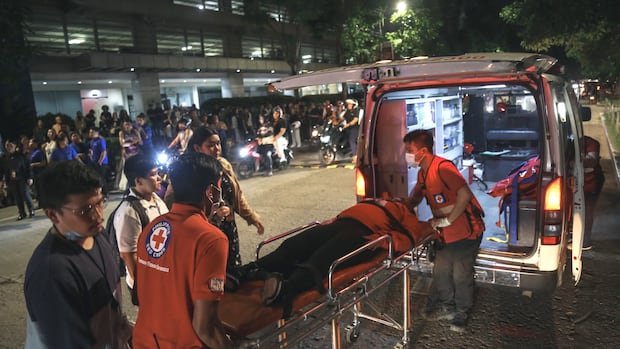
An earthquake with a magnitude of 6.9 struck off the coast of the central Philippines, causing significant damage to houses and buildings late Tuesday. The disaster resulted in the loss of at least 69 lives, numerous injuries, and power outages as residents fled their homes in darkness due to the intense tremors.
The epicenter of the quake, triggered by a local fault, was located approximately 17 kilometers northeast of Bogo, a city of around 90,000 residents in Cebu province. Reports indicated that at least 14 individuals lost their lives in Bogo, with expectations of the death toll rising.
Rescue teams faced challenges in reaching affected areas, particularly in a mountain village hit by landslides and boulders. In San Remigio town, south of Bogo, six individuals, including three coast guard personnel, a firefighter, and a child, lost their lives. The town’s vice-mayor highlighted the urgent need for food and water due to damages to the water system caused by the earthquake.
In Bogo, structures such as houses, a fire station, and roads suffered damages from the quake. Emergency responders provided aid to injured residents, including an elderly man with head injuries. The situation remained tense as aftershocks continued to shake the region, prompting hundreds of residents to seek refuge in open spaces.
Additionally, significant damage was reported in businesses and roads, with visible cracks in the asphalt and concrete. The local Roman Catholic church in Daanbantayan town also sustained damage. The governor of Cebu, Pamela Baricuatro, announced efforts to deploy emergency medical teams to assist those trapped or injured in the aftermath of the disaster.
The Philippine Institute of Volcanology and Seismology issued a brief tsunami warning for coastal areas in Cebu and nearby provinces, cautioning residents to stay away from shorelines. Despite concerns, no unusual waves were observed, and the warning was eventually lifted.
The earthquake struck at a challenging time for the region, as communities were still recovering from a recent storm that caused significant casualties and widespread destruction. The Philippines, situated in a seismically active zone known as the “Ring of Fire,” experiences frequent earthquakes and volcanic activities, in addition to being prone to typhoons and storms.

