
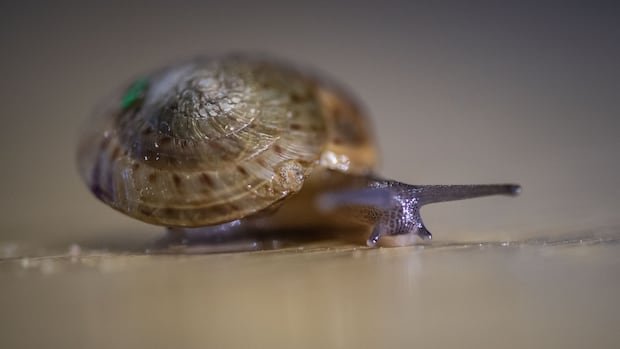
A decade ago, the last known group of greater Bermuda land snails was found in an alley in Hamilton, the capital city. They had settled on concrete slabs near a dripping air conditioner, creating a habitat. Today, these native creatures seem to be thriving once again in the wild, thanks to conservationists who bred them in captivity. Over the past seven years, more than 10,000 snails have been released into protected wooded areas in the archipelago.
Katie Kelton, an invertebrate keeper at the Chester Zoo in the UK, expressed excitement about the snails’ progress, noting confirmed breeding and increasing numbers. The joint efforts of Chester Zoo, Biolinx Environmental Research in Canada, and the Bermuda government have contributed to the success of this decade-long project. A publication detailing the program’s achievements will soon appear in Oryx, The International Journal of Conservation.
Despite their resurgence, the snails still confront threats such as habitat loss and invasive predators, factors that almost pushed them to the brink of extinction. The importance of these tiny creatures lies in their significant role within Bermuda’s ecosystems. They serve as decomposers, breaking down leaf litter to enrich the soil. Additionally, their shells provide calcium for natural predators like birds and reptiles, aiding in strong egg production.
Recognized as critically endangered by the International Union for Conservation of Nature (IUCN), the greater Bermuda land snails faced near-extinction due to human interference and the introduction of invasive predatory species. Their successful reintroduction was celebrated by the IUCN during Reverse The Red Day, an event that honors efforts to combat biodiversity loss.
Kelton shared her joy in working with the endangered snails, highlighting the team’s dedication to saving them. While the re-introduced snails have thrived in protected woodland sites, their long-term survival remains uncertain. Timothy Pearce, a mollusk curator at the Carnegie Museum of Natural History, emphasized the importance of ongoing research to secure the snails’ future in the wild.
Despite challenges, the re-introduced snails have successfully bred on offshore islands, expanding their presence and reintegrating into local ecosystems. Notably, Nonsuch Island, a nature reserve, has provided a conducive environment for the snails to flourish. Continuous efforts, including predator control and public awareness campaigns, are crucial to safeguarding the colonies’ well-being.
Kelton expressed her pride in contributing to the conservation of these beloved snails, emphasizing the importance of giving every species a fighting chance.

