
The Dutch government has agreed to repatriate thousands of fossils to Indonesia from a renowned collection following a commission’s ruling that they were taken during the colonial era “against the will of the people,” as announced by the education ministry on Friday. The Dubois Collection, an important assortment that includes a skull fragment discovered in Java’s Solo River, considered the initial fossil evidence of Homo erectus, a presumed predecessor of Homo sapiens, also known as “Java Man.” This decision marks another step in the Dutch government’s efforts to return art and artifacts acquired, often forcibly, from various countries during colonial times.
The fossils, totaling over 28,000 pieces, were unearthed in the late 19th century by Dutch anatomist and geologist Eugene Dubois when Indonesia was under Dutch colonial rule. Following a detailed investigation, the Dutch Colonial Collections Committee determined that the fossils were likely obtained against the locals’ consent, constituting an act of injustice. The fossils held both spiritual and economic value for the indigenous population, who were pressured to disclose fossil locations.
Minister of Education, Culture, and Science Gouke Moes, along with his Indonesian counterpart Fadli Zon, formalized the agreement at the Naturalis museum in Leiden, where the collection is currently housed. Moes emphasized the thorough research behind the committee’s recommendation, underscoring the importance of maintaining the collection for scientific study, a sentiment shared by both Indonesia and the Netherlands. Homo erectus originated in Africa around two million years ago, spreading to Asia and potentially Europe, reaching Java more than 1.5 million years ago.
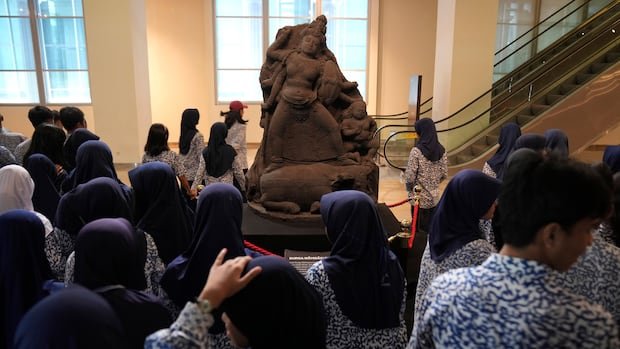
The Netherlands has a history of returning stolen artifacts from its colonial past, having previously repatriated items to Indonesia and Sri Lanka in 2023 and 2024, including Hindu-Buddhist sculptures. Other Western nations are also engaging in similar initiatives, acknowledging and addressing their colonial legacies. Recent examples include France returning indigenous skulls to Madagascar and Germany offering to return human remains from its former African colony.
While repatriation efforts have gained momentum globally, Canada lacks federal legislation facilitating the return of cultural artifacts from museums. Repatriation in Canadian museums typically occurs on a case-by-case basis, with instances like the Royal Ontario Museum returning possessions of a Plains Cree chief to descendants in 2023. Indigenous groups in Canada continue to advocate for the return of artifacts and ancestral remains taken during colonization, with ongoing efforts to secure repatriation agreements with museums worldwide.

