
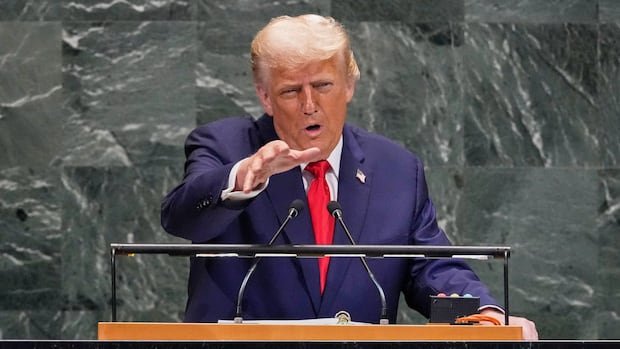
U.S. President Donald Trump made his first in-person speech at the United Nations General Assembly in seven years on Tuesday, criticizing green energy policies and migration issues in various countries. During the event, Trump engaged in bilateral meetings, suggested NATO countries should intercept Russian aircraft in their airspace, and expressed newfound optimism about Ukraine reclaiming lost territory.
While the UN General Assembly’s theme this year is “Better Together,” Trump’s remarks diverged from this theme as he emphasized countries defending their citizens. He defended his administration’s efforts to secure the southern border and raised concerns about migration’s impact on Western Europe. Additionally, Trump criticized UN programs aiding refugees, calling them counterproductive.
Trump dismissed climate change as a deception, labeling it as the “greatest con job ever perpetrated on the world.” He highlighted the negative effects of immigration and costly renewable energy on the free world and the planet. Trump also addressed various geopolitical issues, including criticizing countries recognizing a Palestinian state and discussing conflicts like the Israel-Hamas war in Gaza.
Trump’s address also touched on his administration’s foreign policy changes, such as reducing foreign aid, withdrawing from international organizations, and undertaking military actions against alleged drug smugglers and nuclear facilities. He reiterated his claim of ending seven wars this year without providing specifics, mentioning ongoing conflicts like the Israel-Hamas war in Gaza and Russia’s invasion of Ukraine.
Regarding the Russia-Ukraine conflict, Trump expressed hopes for Ukraine’s success and urged European nations to reduce energy dependence on Russia. He emphasized the importance of NATO countries confronting Russian aggression in their airspace. Trump’s support for Ukraine to reclaim lost territory signaled a significant shift in his stance towards the conflict.
In conclusion, Trump’s address at the UN General Assembly covered a wide range of topics, reflecting his administration’s foreign policy priorities and global perspectives. His statements on immigration, climate change, geopolitical conflicts, and alliances showcased his administration’s approach to international affairs.

