
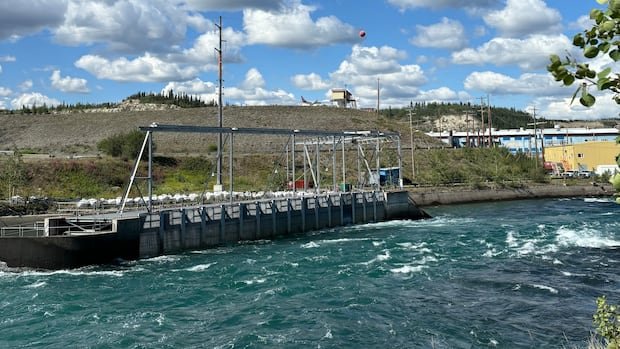
Last year, a total of 761 fish died below the Whitehorse dam during maintenance work conducted by Yukon Energy to protect fish. A consultant’s report obtained by CBC News through an access to information request revealed that the incident occurred in October when water levels below the dam dropped too low, leading to the fish stranding at higher levels than in previous years.
The report, conducted by Environmental Dynamics, identified the fish casualties as 447 slimy sculpin, 172 juvenile Arctic grayling, 133 longnose suckers, and one juvenile chinook salmon. The maintenance work involved removing fish screens and steel beams to prevent chinook salmon from entering turbines before the river froze. This action caused a rapid dewatering of sensitive areas below the dam.
The high Yukon River levels last year, combined with limited storage in Schwatka Lake, hindered Yukon Energy’s ability to reduce flows gradually. Consequently, flow rates had to be reduced more quickly than in previous years, resulting in a swift water level change. The Department of Fisheries and Oceans is currently investigating the issue, declining to comment at this time.
Yukon Energy is taking steps to prevent a similar incident from occurring in the future. Kirsten Hogan, a member of the company’s technical working group for the dam, emphasized the importance of protecting fish and their ecosystems. Changes include implementing a plan to slowly reduce flows, allowing fish to naturally respond to changing water levels and avoid stranding. Additionally, the company has adjusted its ramping protocol to support these efforts.
Hogan mentioned that Yukon Energy has enhanced its surveying of sensitive areas prone to stranding, particularly upstream of the dam. Mechanizing the process of removing fish screens each fall, such as using a lift, is being considered as a potential improvement. With lower water levels this year and decreasing inflows, the company is committed to preserving fish populations, recognizing their significance to local First Nations and the ecosystem.

