
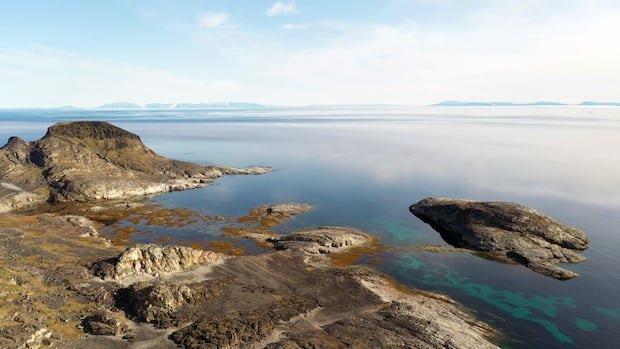
Archeologists unearthed the remains of an ancient encampment on a secluded High Arctic island dating back over 4,000 years. This discovery sheds light on the early inhabitants near the present-day Canada-Greenland border who seized the opportunity to explore a thriving ecosystem that emerged during that era.
The Paleo-Inuit archaeological site, located in Kitsissut, a rugged group of islands between Greenland and Ellesmere Island, poses a challenging journey even today, requiring at least a 53-kilometer boat trip through harsh High Arctic sea conditions from the nearest shore. Lead researcher Matthew Walls, in a new study published in the journal Antiquity, highlighted the remarkable feat it would have been for ancient people to reach this location using watercraft.
Walls estimated that reaching Kitsissut by canoe or kayak would have demanded 12 to 15 hours of strenuous paddling, with the weather potentially shifting from calm to stormy along the way. The site reveals evidence of frequent human visits and stays, indicating sustained long-term occupation.
University of Toronto Arctic archaeologist Max Friesen, not directly involved in this study but collaborating with its authors, suggested that the Paleo-Inuit possessed advanced seafaring technology beyond previous assumptions. The discovery of fragments from their boats implies the presence of canoe- or kayak-like vessels constructed from animal skins stretched over wooden or bone frames.
Friesen, who supervised Walls during his PhD, noted that the Paleo-Inuit inhabited various regions in the High Arctic. Their ability to repeatedly travel to Kitsissut suggests proficiency in activities like offshore seal hunting or even whale hunting, expanding their resource utilization and ecological impact in ancient times.
The archaeological site features 18 tent rings on beach ridges at Kitsissut. These circular areas, likely used for habitation, were equipped with stone rings, central hearths, and divided spaces for different activities. Radiocarbon dating of a seabird bone from the site estimated its age at 4,000 to 4,400 years, coinciding with the emergence of the Paleo-Inuit in the High Arctic.
Around the same period, the region experienced the development of a bountiful ecosystem at Kitsissut, attributed to the creation of the Pikialasorsuaq or North Water polynya, a rare open-water channel in the sea ice. This ecological hotspot supported phytoplankton blooms, fostering a rich food chain and attracting seabirds and marine mammals to the area.
The findings underscore the importance of Indigenous communities in shaping Arctic ecosystems and advocate for their ongoing stewardship. Lesley Howse, director of archaeology at the Inuit Heritage Trust, emphasized the Paleo-Inuit’s aquatic skills, essential for survival in the northern environment where reliance on all available resources, including marine life, was crucial.
The research illuminates the adaptive strategies of early Arctic inhabitants and their intricate relationship with the surrounding environment, offering valuable insights into ancient seafaring technologies and resource utilization practices.

